
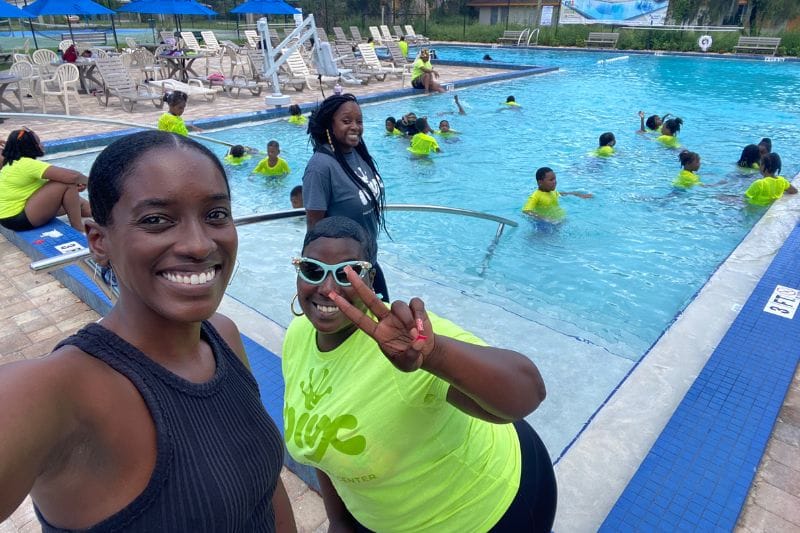
Swim Safety For All Seasons
How Alma Swim Foundation is instilling confidence throughout Central Florida
When Danielle Hodge was around five years old, she nearly drowned. Thankfully, her brother was there to pull her out of the pool, but that moment stayed with her. “As I got older, I realized how common that story was within the Black community and how many people never had the opportunity to learn how to swim,” she explains. The Brooklyn native moved to Altamonte Springs when she was two and spent her childhood there, eventually moving to New York.
Hodge returned to the Sunshine State in 2016 to be closer to family, and it was then that she first launched Alma Ocean, a line of culturally inspired aquatic accessories like inflatable floats, pools and towels, in hopes of bringing more diversity into the pool and beach accessory market. “I knew that representation with products wasn’t enough. We also needed resources, access, and education. That’s what led me to launch Alma Swim Foundation,” she says.

Fast forward to today, and both Alma Ocean and Alma Swim Foundation are working hand-in-hand towards the same goal. “I often say I’m on a mission to get more melanin in the water because, for far too long, many Black families have been disconnected from swimming due to historical barriers, lack of access, and generational fear around water. I’m passionate about changing that narrative,” Hodge says. “I want Black children to grow up seeing swimming not as something that’s ‘not for us,’ or that ‘we don’t do,’ but as a life-saving skill, a form of wellness, a source of joy, and a space where they belong.”
According to Hodge, the biggest hurdle people face is the fear and anxiety that comes with learning to swim. Layer on the fact that lessons can be expensive, transportation can be challenging, and many families don’t know where to start or who to trust, and it begins to feel like an impossible task, especially for older kids or adults who’ve spent much of their life avoiding the water. “That’s why our work is about more than teaching swimming. It’s about breaking cycles, building confidence, and helping families see that the water can be a place of joy, not fear,” continues Hodge.
Related: 11 Family-Friendly Fitness Spots to Stay Active in Central Florida
She recalls one story about an Eatonville resident named Robin who spent her entire life afraid of the water. After hearing about Alma Swim’s lessons, it sparked her curiosity, leading her to go home, change into a swimsuit, and return. After a few lessons, she was doing things she never thought possible and began trusting herself in a totally new way. “She even joined us on a surf outing,” explains Hodge. “I’ll never forget watching her get up on a surfboard. Here was a woman who had spent years avoiding the water, and now she was on a surfboard, smiling from ear to ear. I was in complete awe. Not just because of her progress, but because I was witnessing the impact of this work unfold right before my eyes.”
Since Alma Swim Foundation formed in 2013, the organization has helped more than 2,000 children and adults gain access to swim lessons and water safety resources and raised funds to support community programming and lifeguard scholarships. “We’re not just teaching people how to swim. We’re creating pathways into aquatics careers and helping build a more diverse aquatic workforce,” says Hodge. “My favorite thing is when a family reaches out looking for swim lessons and then later comes back as a volunteer, donor, advocate, or partner. That’s how I know we’re building a true community, not just a program.”
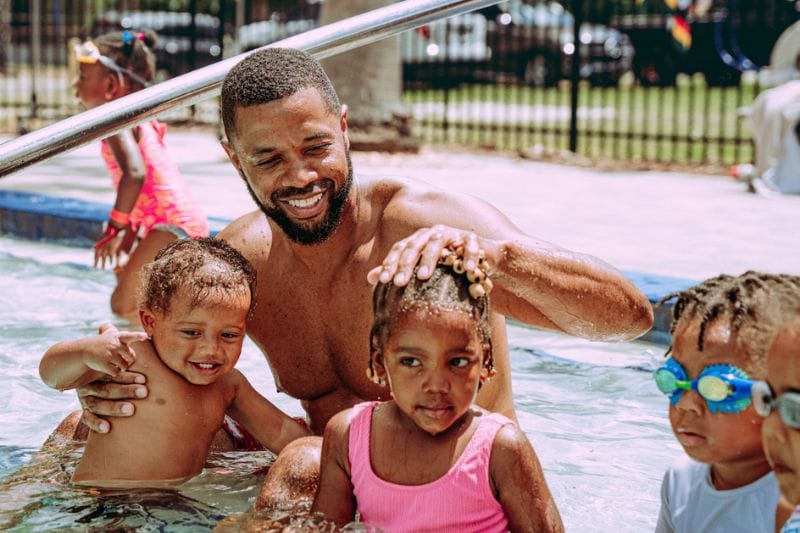
5 Swim Safety Rules
1. Teach Kids to Respect All Water
Many parents focus on pools, but lakes, ponds, beaches, retention ponds, and even bathtubs can be dangerous. Water safety should be taught everywhere.
2. Make Sure Children Know How to Call 911
In an emergency, every second matters. Older children should know how to recognize an emergency and call for help.
3. Put the Phone Down
When children are in or near water, avoid scrolling, texting, or taking long phone calls. Water watching requires your full attention. Most people imagine splashing, yelling, and waving for help. In reality, drowning is usually silent.
4. Choose Swim Locations with Trained Lifeguards
When possible, swim at pools, beaches, and water parks where certified lifeguards are present. Layers of protection matter when it comes to water safety.
5. Learn CPR
Kids can actually learn CPR too! We teach it at our annual April Pools Day event to the kids in partnership with the Red Cross. CPR can save a life before emergency responders arrive. Every parent, grandparent, caregiver, and babysitter should know it.
Swimming in Orlando:
- Orlando’s Coco Key on International Drive: How to Plan a Relaxed Water Park Day
- The Best Places to Go Swimming with Kids in Orlando: Water Parks, Springs and more!
- 3 Reasons Every Child in Florida Needs Swim Lessons
Originally published in the September/October 2026 Issue of Orlando Parenting Magazine
